We had both halves of the comparison for 451 Persian pages: the snippet Google actually displayed, and the meta description the page itself declares. Google ignored the page's own description and wrote its own sentence on 327 of them. That is 73 percent.
Writing short did not help. Pages with a description under 160 characters got theirs used 26 percent of the time. Pages that ran over 160 got theirs used 33 percent of the time. Every SEO checklist in the world has that relationship backwards.

How the numbers were produced
Eighty-five Persian search queries were already sitting in our SERP cache from other work. Each organic result carries the snippet Google chose to show. We pulled those, then on 19 August 2026 we opened the pages themselves in headless Chrome and read the meta name="description" tag out of the markup. 498 pages across 413 domains answered with a 200; 451 of them had both sides.
The match test was deliberately strict. If the first 70 characters of the snippet appeared inside the page's description word for word, we called it used. If it was not identical but shared three quarters of its words, we called it partly used. Anything else counts as Google writing its own. We stripped the date prefix Google sometimes prepends before comparing, because leaving it in would have inflated the result in our favour.
| What Google displayed | Pages | Share |
|---|---|---|
| The page's meta description, verbatim | 110 | 24% |
| Nearly it, lightly edited | 14 | 3% |
| Text Google assembled from the page body | 327 | 73% |
The displayed snippets had a median length of 160 characters and a maximum of 170. So the familiar advice to stay near 155 characters is correct as a display limit. It simply has nothing to do with whether your text gets picked.
Google says this in its own documentation
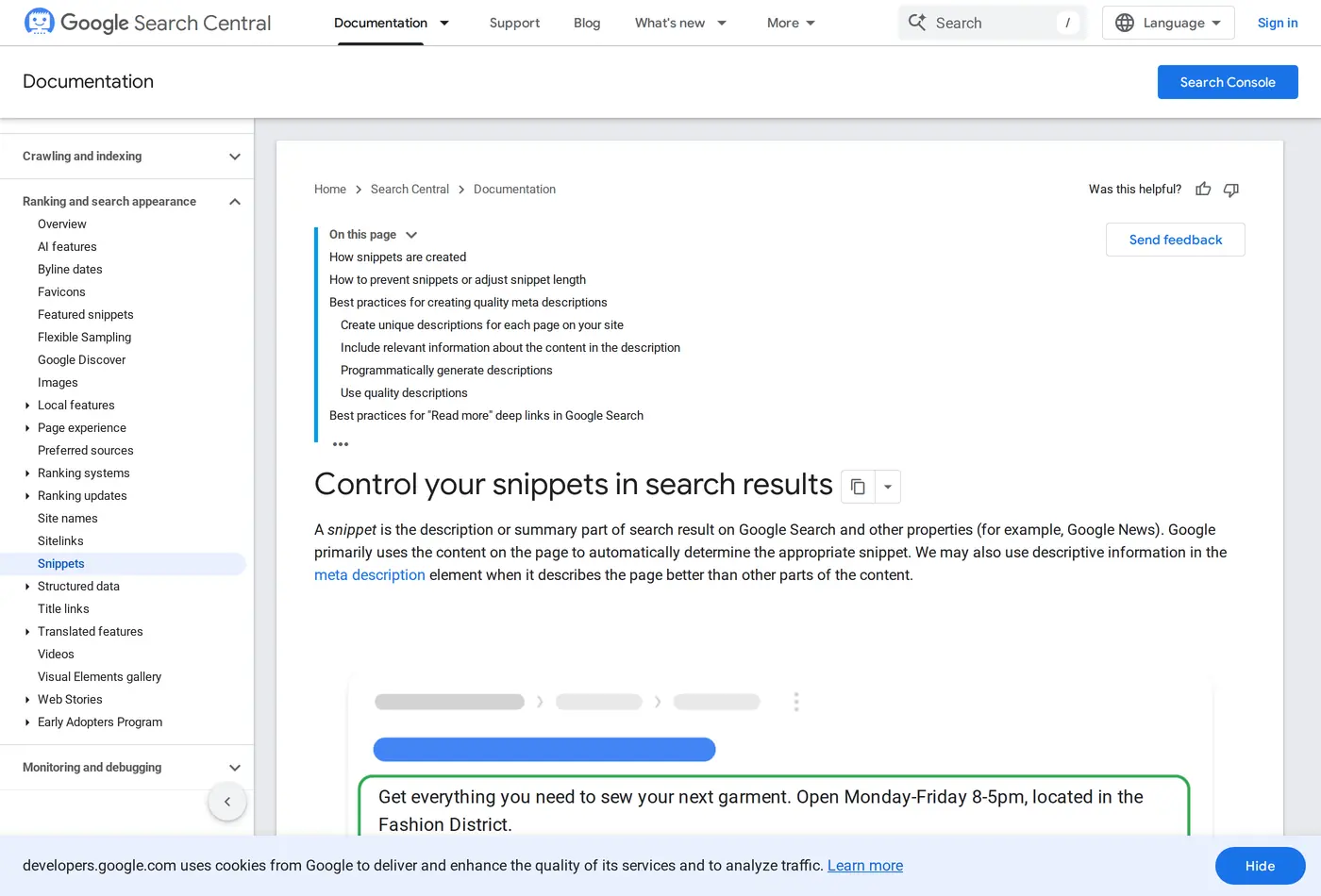
The snippet page in Search Central contains one sentence that explains the whole result. Google primarily uses the content on the page to determine the snippet, and may also use the meta description element when it describes the page better than other parts of the content.
Nobody reads that "may" as seriously as they should. Our measurement says that in Persian, three times out of four, the answer to that condition is no.
So why write one at all
Because the 27 percent is not randomly distributed. When somebody searches your brand name, your home page has no paragraph that answers that query, so the meta description is the only ready-made text Google has. Brand queries, product-name queries, contact pages and category archives are where your sentence actually reaches the results page.
Our position: write the description for the person who already knows your name and is looking for you. For the person who does not know you exist yet, what decides the snippet is the body copy, because that is where Google builds it from.
Forty-six pages had none, and one had thirteen thousand characters
452 of the 498 pages carried a meta description and 46 carried nothing. Fifteen of those 46 did have an og:description, meaning the text was ready for Telegram and LinkedIn but not for Google. That pattern usually comes from a theme that never wires up the SEO field, not from a decision anyone made.
The length distribution is worth a look on its own. Median 146 characters, ninetieth percentile 186, shortest 26. Eighty-three pages, 18 percent of those that have a description, run past 160 characters and get cut in display. Two pages were over a thousand characters, and one of them, on limoo.host, carried a meta description of 13,034 characters. That is not a description. That is an entire article pasted into the head.
Our own site failed the same test
Before writing any of this for a client, we ran the same check against our own home page. On the same day, the rgb.ir home page description was 181 characters and the English version 193. Both get truncated. Our SEO service page is 148 characters and is fine.
We are publishing that because 181 is exactly the mistake we counted on 83 other pages, and hiding it while counting everybody else would be worthless. Fixing it is on this month's list.
What is actually worth the hour
If 73 percent of snippets are assembled from body copy, the useful work is making the opening paragraph of each page answer the query on its own. Google usually takes it from there, or from whichever paragraph the query words cluster in. That is the same argument our the on-page list we hand clients makes, and it has nothing to do with a plugin field.
The order we recommend is: the first paragraph, then the title tag, then the meta description third. If there is only time for one of the three, drop the third.
Where the limits of this measurement are
Snippets are not fixed. Google can pull a different passage of the same page for a different query, so one URL can show two different snippets. The numbers above come from one query per page.
The SERP data was collected between 14 and 19 August and the pages were read on 19 August. Any site that changed its description inside that window is sitting in the wrong column. Across 451 samples that does not move the conclusion, but it is real.
One more thing worth saying plainly: the only Iranian location code DataForSEO exposes is 20498, which is East Azerbaijan Province rather than the country. It is the only option available and we always name it.
Questions people actually ask
Where does the meta description live?
Inside the page's head, as meta name="description". In WordPress it is normally filled in by an SEO plugin, which puts a field under the editor.
Is it a ranking factor?
No. The only thing it does is let you own the sentence under your title on the occasions when Google decides to use it. In our sample that was 27 percent of the time.
Does WordPress write one by itself?
Not for posts and pages. Without an SEO plugin, the tag is simply absent, which is what we found on 46 pages.
How long should it be?
Under about 160 characters if you want the whole thing displayed. The longest snippet Google displayed anywhere in our sample was 170 characters.
If you want to see what Google is currently showing for your own URLs, our Google rank checker returns the result exactly as a searcher sees it. And if the answer turns out to be that your body copy does not answer the query, no description field is going to rescue it.
Measured 19 August 2026. External source: Google Search Central, snippet documentation.



Comments & Questions
Have a question about this article? Ask, we'll answer.
No comments yet; be the first.