We bought search volume for 794 phrases. In Iran, 416 of them came back as zero. Not small. Zero. Every one of them was being searched somewhere in the world, and most carried a large global number.
That is the single figure worth knowing before you open any keyword tool. The global number does not describe your market, and the size of the error is not something you can guess.

What was measured, and how
Between 14 and 19 August 2026, across several calls, we pulled clickstream search volume for 794 phrases. Clickstream returns two things per phrase: a global volume and a country distribution. The Iranian figure is the product of the two. The whole exercise cost under a dollar.
The phrases came from the markets we work in, hosting, domains, SEO, web design, graphics, AI tools, freelancing. A sample we chose, in other words, not a random draw.
Half the list has no local demand at all
416 of 794 phrases had no measurable Iranian share. 378 did. If your keyword list came out of a global tool, roughly half of it is addressed to nobody.
The 112 fresh phrases we measured this morning make the point sharper, because every one of them looked reasonable on paper. Seventy-one returned zero. «Rank tracker» in Persian: zero. «Keyword tool» in Persian: zero. «Google index» in Persian: zero. These are the phrases a technical person assumes are typed constantly, and they are not.
The multiplier is not stable
For the 378 phrases that do get searched in Iran, the ratio of the global number to the Iranian one looks like this:
| Percentile | Global figure divided by Iranian figure |
|---|---|
| minimum | 1x |
| median | 2.4x |
| 75th | 4x |
| 90th | 126x |
| 99th | 1,937x |
| maximum | 4,064x |
Median 2.4, maximum 4,064. There is no correction factor you can apply. Some phrases are almost entirely Iranian and some are off by three orders of magnitude.
There is a rule, and it is the alphabet
For phrases written in Persian script, the median Iranian share is 44% and the median multiplier is 2.3. For phrases written in Latin script, the median Iranian share is 0.38% and the median multiplier is 267.
| Phrase | Global | Iran | Share |
|---|---|---|---|
| claude code | 13,950,423 | 41,933 | 0.3% |
| gemini 3 | 3,530,288 | 9,599 | 0.27% |
| ga4 | 899,842 | 2,466 | 0.27% |
| gemini فارسی | 1,204 | 1,000 | 83% |
| «site analysis» in Persian | 5,543 | 4,466 | 80.6% |
| «speed up a website» in Persian | 776 | 532 | 68.7% |
So «claude code», with nearly fourteen million searches worldwide, is forty-two thousand in Iran. A perfectly respectable number. But if fourteen million is what shaped your content plan, the plan is wrong by a factor of three hundred.
Why Keyword Planner does not settle this for you
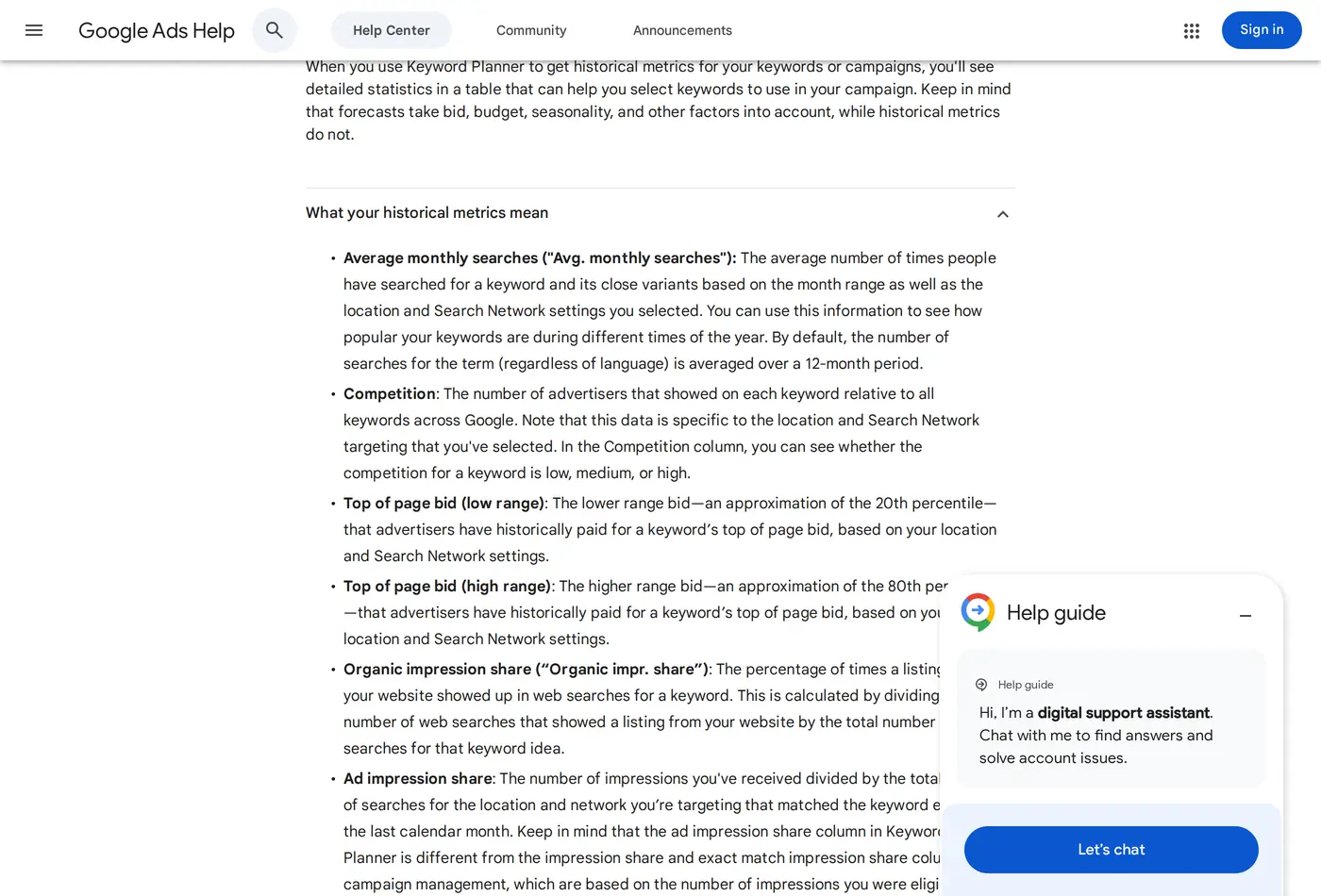
Google's own help page says the average monthly searches figure is «specific to the location and Search Network targeting that you've selected» and that «your search volume statistics are rounded». Set the location wrong and the number you are reading is somebody else's. Google has always said so.
The difficulty is that setting it correctly from an Iranian account is not straightforward, and the market has already answered in public: one of the top related searches on the Persian query for Keyword Planner is «buy a Google Keyword Planner account». When that is the workaround, you are reading the number through a stranger's settings.
Our own experience matches. A search-volume request to Google's ads endpoint for an Iranian location returns an error, and the crawl-built keyword databases are close to empty for Persian. Clickstream was the only source that answered, which is why it is the one we use.
Where these numbers are weak
Clickstream is panel data, not Google's ledger. Both the global volume and the country split are estimates. For a phrase with a small global total, the country share rests on a small sample and is noisy. A zero here means «not observed in this panel», not «no Iranian ever searched it».
And 794 phrases from a handful of industries is a sample, not a census. If you work in medicine or law or education the pattern may differ. Take the method, not our numbers.
What to do on Monday
If the phrase is in Latin script, treat the global figure as meaningless for your decision until you have seen the local share. If it is in Persian script, the global figure is roughly double yours and is workable, but confirm it anyway.
More important than either: look at what the first page actually contains before you write for a phrase. A hundred searches a month against a weak first page will bring you more business than ten thousand against a wall of specialists. We set that out step by step in our walkthrough for finding a Persian keyword.
If you would rather we ran this against your own list, pulling keywords with real Iranian volume is exactly that job: the local figure, not the global one. And if the question is still what counts as a keyword in the first place, start with the definition and the types.
One closing point that keyword research keeps teaching people late. A good list does not rescue a bad site. If the page meant to rank is slow or badly structured, no phrase changes that. The free checks we host ourselves come first for that reason, and when the foundation is the problem, building the site on a sound base beats any amount of research.
Search volume from clickstream data, collected 14 to 19 August 2026. 794 unique phrases. The raw file is ours and we kept it.



Comments & Questions
Have a question about this article? Ask, we'll answer.
No comments yet; be the first.