In May 2026 Google added a section to the Search documentation called generative AI fundamentals, and for the first time it stated officially what you need to do to appear in AI features, and what you do not.
The "do not" list rejects several things currently being sold as a separate service.

Four things Google said are not required
These come straight off the page, not from anyone's interpretation of it.
No separate machine readable file. Google says you do not need to create new files for AI consumption, because Google Search itself does not use them. That sentence is aimed squarely at llms.txt and its relatives.
No chunking your content. There is no requirement to break an article into small blocks for a model to digest.
No special writing style for AI. You are not supposed to write differently so a model reads you better.
Structured data is not mandatory. Schema is not a condition for appearing in generative AI features. It remains useful for ordinary rich results, but the two are not the same thing.
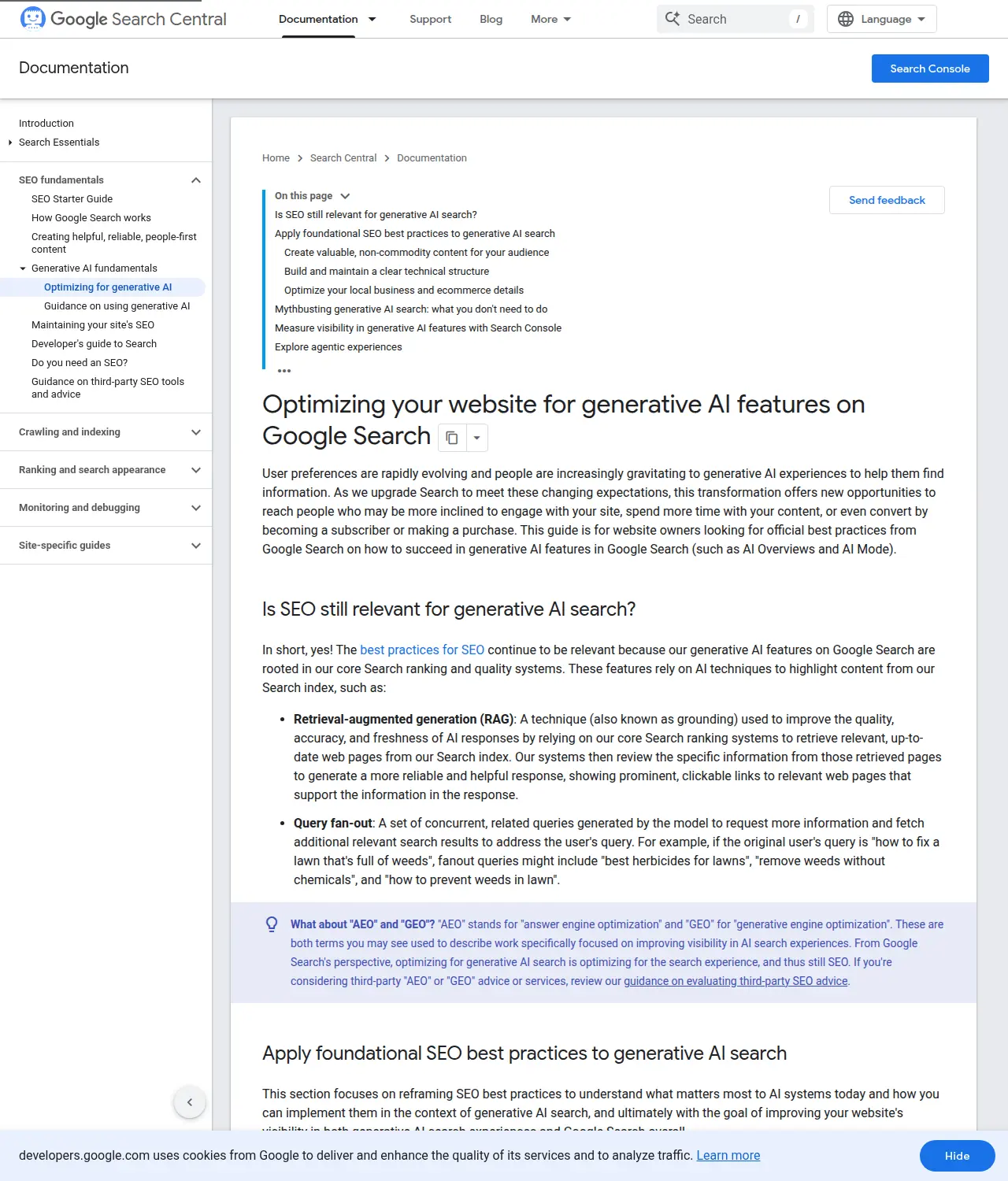
Google's answer on AEO and GEO
The same page carries a separate callout aimed straight at the two terms currently being sold.
Google writes that AEO and GEO are both terms used to describe work focused on visibility in AI search experiences, and that from Google Search's perspective, optimizing for generative AI search is optimizing for the search experience, and thus still SEO. It then points readers who are considering third party AEO or GEO services towards its guidance on evaluating third party SEO advice.
That is the most direct sentence we have seen from Google on those two acronyms.
What Google did ask for
The same things it has asked for over the past decade, with one fresh emphasis: content with a point of view of its own rather than a rewrite of what everyone else has published. A page that is crawlable, indexed, and meets the technical requirements of Search. A readable structure with semantic HTML and real headings, built for people rather than for a model. Relevant images and video where they genuinely help.
Then monitoring the result through the generative AI performance report in Search Console, which shipped a few weeks later.
The whole thing reduces to one sentence: there is no new discipline here, it is still SEO.
We publish an llms.txt and we still say this
On this site, rgb.ir/llms.txt returns a real file. We put it there and we are not removing it.
Not because we think it affects Google rankings. It does not, and the documentation above says so. We keep it because crawlers other than Google exist and some of them read that convention. The cost to us is one text file.
The distinction that matters is that we do not sell it to anyone or invoice it as AI optimisation. If somebody is charging you separately to create a text file and promising you Google results for it, Google's own documentation has already answered them.
One contradiction you should hold onto
Say this too, because the section above is one sided without it.
Google is talking about Google Search. ChatGPT and Perplexity and the rest are not Google Search and they set their own policies. That Google ignores a file does not make the file useless everywhere.
So the honest framing is this. For visibility in Google, the same SEO. For visibility in other tools, nobody has enough data yet, and anyone claiming a method is guessing. Including us.
What to actually do
If you have set aside a budget for AI optimisation, we would spend it in this order.
First make sure your pages are indexed at all. A page outside the index is in no AI answer either. The diagnostic order is in how to trace a ranking drop to its cause and the same path works here.
Second, invest in the pages that carry something nobody else has: your own number, your own experience, the limitation others will not write down. Google's documentation calls exactly this non-commodity content.
Third, tidy the structure of the page for the reader. Proper headings and semantic HTML, which is what the pre-publication check for any page already covers and what the AI documentation now repeats.
Fourth, open the new Search Console report and find out whether you are getting impressions in these features at all. How it differs from the older reports is covered in how this report differs from the older Search Console views.
Where to go next
If your site carries a lot of content and you are not sure which pages are genuinely visible, an index and content structure review starts from that point rather than from buying a package with a new name on it.
And if your site is new, the most useful thing you can do for any kind of search is to make the pages crawlable and fast from day one. Building with the technical structure right settles that at the start.
Sources
- Google's guide to optimising for generative AI in Search, the official documentation and the source of everything above
- The Search Central announcement of that guide
Both sources were checked on 15 August 2026.



Comments & Questions
Have a question about this article? Ask, we'll answer.
No comments yet; be the first.