IRNIC's rules place no nationality condition on the holder of a .ir domain. Annex 1 states that the applicant may be any natural or legal person for whom granting the domain would not conflict with the laws and regulations of the Islamic Republic of Iran. That is the entire applicant condition.
The first page of Google for this question is fifteen illustrated tutorials from hosting resellers, each showing where to click. Not one of them quotes the regulation itself, and the regulation is what decides whether your domain can be registered at all.

What is actually required
A registration identifier, which IRNIC calls a nic handle. The applicant fills in the handle request form and receives one.
The part that rarely gets mentioned: if your administrative, technical or financial contact is a different person, each of them needs a handle too. So if your company wants the domain in its own name but the technical lead is somebody else, that is two handles, not one.
The registration form is then submitted electronically. According to the same annex, submitting it constitutes acceptance of the whole set: the terms and conditions, the dispute resolution policy, the dispute procedure, the WHOIS policy and the fee schedule. The form requires the holder's full legal address, a telephone number and the registrar's details.
What is absent from the regulation matters as well. The documents each reseller asks for, and how they verify identity, are not in this text. Registrars decide that themselves and they differ. So when somebody tells you "this is the rule", ask which clause they mean.
"Register .ir without identity verification" has an answer
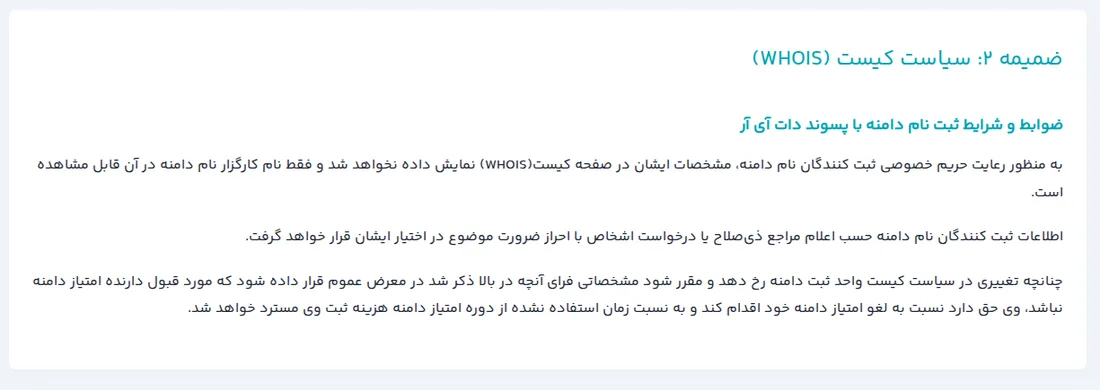
That phrase is one of the related searches on this keyword, and the answer comes in two parts. First: without a handle and without a full legal address, no domain is registered. Staying anonymous to IRNIC is not on the menu.
The second part is more interesting and is written almost nowhere. Annex 2 says the registrant's details are not displayed on the WHOIS page, and only the registrar's name is visible. On a .ir domain, WHOIS privacy is the default. On a .com you usually pay for it.
That same annex carries a clause few people have read. If the WHOIS policy ever changes so that more information becomes public, and the holder does not accept it, the holder may cancel the domain and receive a refund proportional to the unused part of the registration period.
Names that cannot be registered
Three groups. The first is formal: a name may contain only Latin letters, Latin digits and the hyphen, the hyphen may not sit at the start or the end, and the length must be between 3 and 63 characters.
Second, the exclusive names. The name of the country in any form, the names of provinces, of governorates, of counties and of cities belong to the relevant public bodies. Names of natural, historical, cultural and national monuments, religious names and the names of notable figures sit with the relevant departments of the Ministry of Culture and Islamic Guidance, unless that ministry issues written permission to somebody else.
Third, a published list of generic internet words that cannot be registered under any top level domain. A few entries from that list:
- internet, email, domain, host, hosting-iran
- dns, http, https, ipv4, ipv6
- firewall, gateway, modem, network, lan
- alongside words against public decency or indicating activity contrary to the law
If your brand name is one of these words, find that out before you order a logo and business cards. We have watched a brand get built around a name more than once, only for the domain to turn out to be unregistrable. Choosing a good domain for a brand exists for exactly that stage of the work.
A practical warning about ownership
The domain belongs in your name or your company's, not in your web designer's and not in the reseller's. That sentence reads as filler, and every few months we still meet somebody whose site works and whose domain carries somebody else's name.
Checking is simple.
Log in to the IRNIC panel and see whether the holder's handle is yours. If it is not, chase it today. Transferring a domain is easy while the other party cooperates, and turns into a dispute case when they do not.
.ir or .com
Both, if the budget allows. A .ir signals local presence to a domestic audience and is cheaper to register; a .com makes more sense for an audience outside Iran and for a brand that might one day operate internationally. The SEO comparison of .ir and .com opens that decision up in more detail.
In practice most of the businesses we work with take both and redirect one to the other. The cost of the second one is trivial next to the cost of losing the brand name.
What does an individual need?
A handle, and a completed form with a full legal address and phone number. The regulation sets no further condition on individuals; whatever documents a given registrar asks for is a separate matter.
Can it be registered from outside Iran?
Annex 1 sets no nationality condition and says only that granting the domain must not conflict with the law. A registrar's own practice may be stricter, so ask that registrar before planning around it.
What is the length limit?
Three to sixty-three characters, Latin letters and digits and the hyphen only, and no hyphen at either end.
What if the name is a city?
City, county, province and country names are reserved for the relevant bodies and are not available to the public. Combinations that are not purely a place name sit differently and need checking case by case.
If the domain is for a business you are starting, the name and the site structure are better decided together. Launching a site on a domain that is genuinely yours begins before the name is chosen, and registering the .ir itself is a ten-minute job afterwards.
Method: the text of Annex 1, Annex 2 and the published list of generic internet terms was read directly from the IRNIC site on 16 August 2026. The quotations come from those pages. The identity verification process used by individual registrars is not in these documents, and no claim is made about it here.
The primary text is available in Annex 1, the registration rules, Annex 2, the WHOIS policy and the list of generic internet terms.



Comments & Questions
Have a question about this article? Ask, we'll answer.
No comments yet; be the first.