What stops a download host is rarely the traffic allowance. It is the file count, and the read speed of the disk underneath it. On 16 August 2026 we read the 19 pages that Google returns for the Persian query "download hosting": twelve of them print the word unlimited on the sales page, one publishes an inode figure and an I/O ceiling, and not a single one explains its fair use clause where a buyer would see it.
The one that publishes numbers is 7ho.st. Its technical table lists traffic as unlimited, and two columns over, I/O at 50 Mbit/s across all five plans and an inode allowance running from 1000 on the cheapest plan to 5000 on the dearest.

The inode quota is your real ceiling
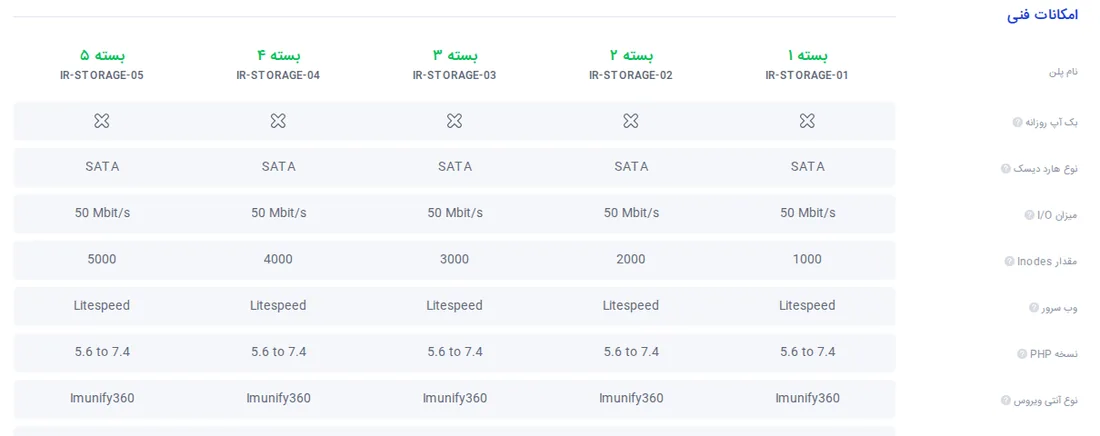
An inode is the number a Linux filesystem assigns to every file, every directory and every link. Anything you create on the account consumes one, including an empty file of a single byte. So an inode quota caps how many things you may store, with no reference at all to how many gigabytes you paid for.
Put that entry-plan 1000 against something real. The WordPress install running this site contains 23,622 files and directories right now. On a plan capped at a thousand inodes, WordPress would run out of quota before it finished copying. For a download host, where the entire job is holding files, that number matters more than the disk figure: if somewhere sells 50 GB of space with a thousand-inode quota, that means roughly a thousand files averaging 50 MB each. Distributing photographs or short audio clips, you never reach the disk limit. You reach the counter.
Inode quotas are normal on shared servers and the engineering reason is sound. Backing up an account holding half a million small files takes hours and slows the whole machine down while it runs. The problem is not that the quota exists.
The problem is that 18 of 19 sellers never name it.
What "unlimited traffic" actually promises
It promises that nobody is counting your monthly transfer. That is a real and useful thing. Your instantaneous bandwidth is still capped, though, and that cap is what your visitors experience. In the same vendor table, I/O sits at 50 Mbit/s. Five people pulling a 200 MB file at the same moment get roughly 10 Mbit/s each, so each download takes close to three minutes. The monthly allowance is still unlimited. Your user is still waiting.
Four numbers worth asking for before you pay, none of which usually appear on the pricing page:
- the inode quota, meaning the cap on file count
- the per-account I/O or instantaneous bandwidth ceiling
- the limit on simultaneous connections to one account or one file
- whether backups are counted against either of the above
Ask in a ticket, before payment, and keep the written answer. A vendor who will not give you a figure is not automatically a bad vendor. You are simply buying without knowing where the ceiling is, and you will meet it on the day you cross it.
The fair use clause nobody reads
None of those 19 pages carried the phrase "fair use" on the product page itself. The clause almost always exists, in the terms and conditions, several clicks away from the price. In practice it reads: unlimited for as long as your consumption resembles everyone else's, and the vendor decides what resembling everyone else means.
We use the same structure, so we should say it plainly. Traffic on the download plans we sell is written as unlimited under fair use too. The difference is not in the wording. It is that the figure exists and we hand it over when you ask.
Where a download host is the wrong purchase
If your files are long videos and your audience arrives at once, shared download hosting is not the tool. Video playback needs a service that does streaming and multi-bitrate encoding, not storage sitting behind a shared port. At the other extreme, if you have an enormous number of very small objects, object storage is both cheaper and better behaved, because it has no concept of an inode to run out of.
The right jobs are the ordinary ones: installer packages, software updates, podcast audio, periodic archives, anything whose count you can predict and whose size you can estimate. That is also why, on a shared hosting account, keeping heavy files away from the site itself is simply good hygiene. The site stops competing with the downloads for I/O.
Split the files off the main site
This is the change we have made on client projects more often than any other, and it is close to free. Heavy files live on a separate account. The site stays on its own hosting. Download links point at another domain or subdomain. A busy download day then has no way to slow your product page down.
The mechanism connecting that to rankings is not mysterious, and how hosting shapes site speed walks the same chain with Core Web Vitals numbers attached.
One consequence people discover late: if the files sit on the site's own hosting and automatic backups are switched on, every backup reads that entire volume again. Three months later the site is mysteriously slow at night, and nobody connects the two.
What is download hosting?
Storage tuned for holding and serving files rather than running a dynamic site. It usually comes with more disk and fewer processing resources, managed over FTP or a stripped-down panel.
Is there such a thing as free download hosting?
Free services generally cap file size, retention period or download count, and wrap the link in advertising. For a file that has to stay reachable for years it is the wrong choice, because a free agreement almost never contains a durability commitment.
Which download host is best?
A better question is which vendor will put the inode quota, the I/O ceiling and the concurrency limit in writing. Between two plans at the same price with the same disk, the one that publishes those three is the lower-risk purchase.
How does it differ from ordinary hosting?
Ordinary hosting is configured to run PHP and a database, and spends its CPU allowance doing that. Download hosting gives you a larger disk and usually a smaller processing allowance, which is why running a shop on it is a poor idea. Our guide to what hosting is separates the families more fully.
If files are part of your product rather than an attachment to it, the site architecture should account for that from the first week. Building a site that delivers its files properly is a different exercise from bolting a download host on in month six, and the difference is exactly what a user feels.
Method: Google organic results for the Persian query, depth 20, read on 16 August 2026 from a server in Helsinki. 19 URLs answered 200 and the served HTML of each was inspected; pages that build their pricing in JavaScript may be undercounted here. The WordPress file count was produced with find on this server.
Sources this piece leans on: the 7ho.st download plan specification table and the Linux inode(7) manual page.



Comments & Questions
Have a question about this article? Ask, we'll answer.
No comments yet; be the first.