Below 100,000 toman a transaction, Zibal costs you less. Above it, ZarinPal does. That crossover is the only figure in this decision that needs actual arithmetic, and neither company has published it, because neither has a reason to.
The reason there is a crossover at all is that the two tariffs are shaped differently. ZarinPal charges a smaller percentage but adds a flat amount to every transaction. Zibal charges a larger percentage and adds nothing. A flat fee is brutal on a small basket and invisible on a large one.

What the two companies actually publish
We read these off their own pricing pages on 16 August 2026. Tariffs move, so check them again before you sign anything.
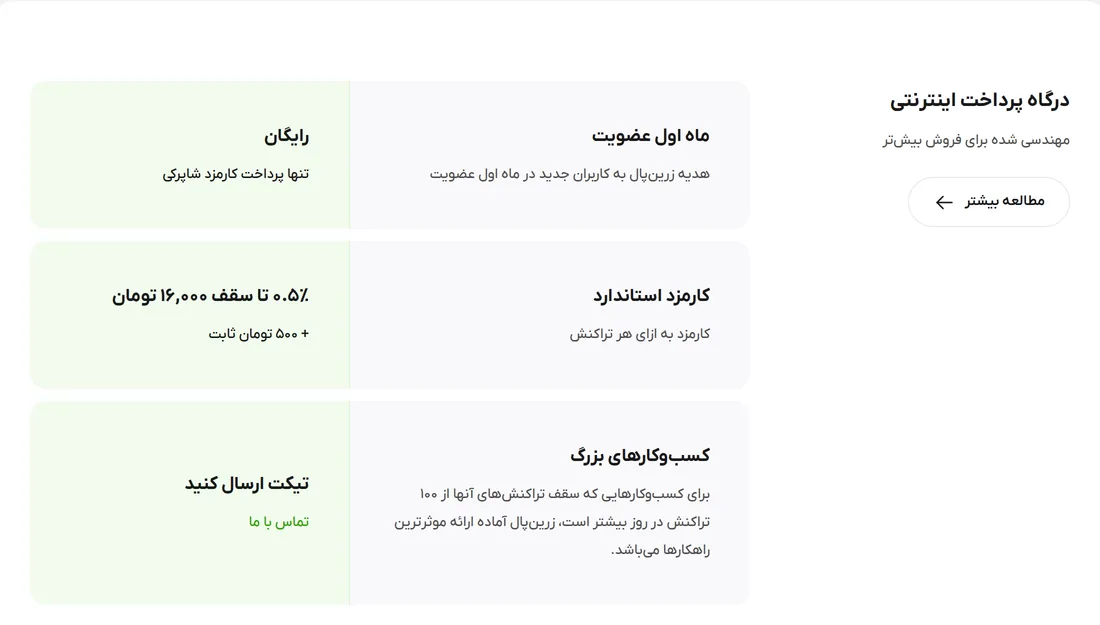
ZarinPal takes 0.5% capped at 16,000 toman, plus a flat 500 toman on each transaction, and gives the first month free. Zibal takes 1% capped at 20,000 toman on its payment gateway, and states that the fee applies only to successful transactions.
Where the lines cross
ZarinPal's fee is half a percent of the amount plus 500 toman. Zibal's is one percent of the amount. Those are equal when half a percent of the amount equals 500 toman, which happens at 100,000 toman. Everything below that point favours Zibal and everything above it favours ZarinPal.
| Transaction | ZarinPal fee | Zibal fee | Cheaper |
|---|---|---|---|
| 50,000 toman | 750 | 500 | Zibal |
| 100,000 toman | 1,000 | 1,000 | identical |
| 300,000 toman | 2,000 | 3,000 | ZarinPal |
| 1,000,000 toman | 5,500 | 10,000 | ZarinPal |
| 2,000,000 toman | 10,500 | 20,000 (cap) | ZarinPal |
The two caps bite in different places. Zibal stops at 20,000 toman once the transaction passes two million. ZarinPal's percentage cap closes at 3,200,000 toman, after which you pay 16,000 plus the same flat 500.
One thing the pricing page will not settle for you. In the phrase "0.5% capped at 16,000 toman plus a fixed 500 toman", it is not stated whether the cap sits on the percentage component or on the total. We have read it as the percentage component. If your transactions run into the millions, that is a question for their support team before you commit, not after.
The costs that are not on the fee card
On a shop doing 300 transactions a month at 300,000 toman each, the gap between the two gateways is roughly 300,000 toman a month. Real money. Three other things are usually bigger, and almost nobody negotiates them.
Settlement timing comes first. Money that lands in your account three days later changes the cash position of a small business in a way that a few thousand toman of fee does not, and you cannot read it off a tariff page. Ask directly.
Then VAT, which Zibal states plainly is added on top of the fee. The numbers in the table above are floors, not final figures.
Then the trust seal. A direct Iranian gateway requires an eNamad certificate, and ZarinPal lists issuing one without a star at 600,000 toman. For a business just starting out, that single cost outweighs an entire first year of gateway fees. Part of qualifying is having the domain and certificate configured properly, so settle that before you apply rather than after you are rejected. If you are reading this from outside Iran, the equivalent is whatever your acquirer demands before it will underwrite you, and the lesson holds: onboarding cost usually beats transaction cost in year one.
What a payment company will never tell you
We do not sell gateways. We build the shop that the payment has to survive, which puts us in a position to see something the provider cannot: across the stores we have launched, the share of orders abandoned on the payment step itself has always dwarfed the difference between two tariffs.
So if you are agonising over half a percentage point while your checkout loads slowly on a phone or asks the customer to register a second time, you are optimising the small number. Measure how long that page takes to load first. Then argue about the tariff.
And the honest boundary on all of the above: this is arithmetic on two published rate cards, not an endorsement. We have integrated both. Neither has given us a reason to prefer it beyond the numbers here.
So which one
Average basket under 100,000 toman, take Zibal. Over it, take ZarinPal. If your transactions are in the millions, both hit their ceilings and the residual gap is about 4,000 toman per transaction, which by then is worth caring about.
If you do not yet have a store for any of this to apply to, postpone the decision entirely. The gateway is the last piece of a shop built so the payment goes through, not the first. We have broken down what the other pieces cost in our writeup on what launching a store actually runs to.
Can you get a gateway without eNamad?
Not a direct one in your business name. Intermediary options exist, with different settlement terms and transaction ceilings, and you should get those conditions from the provider rather than from an article.
Does the fee come out of the seller or the buyer?
By default it is deducted from the seller's settlement. Some shops add it to the price instead, which is legal and does measurably move conversion.
You can check both rate cards yourself: ZarinPal pricing and Zibal pricing. If the figures differ from ours, look at the date above and trust the newer one.



Comments & Questions
Have a question about this article? Ask, we'll answer.
No comments yet; be the first.