Of the seven Iranian freelance platforms we checked, exactly one states its commission on a page you can read without signing up. The rest either do not publish a figure or put it somewhere a search engine and a first-time visitor will not reach.
That is the finding, because a commission you cannot find before you start work is a cost you discover at payout.

Method, and why this test is fair
On 16 August 2026 we opened each platform's help or FAQ page and searched for the words for commission, fee and percentage. Several of these sites are single-page applications whose content is built with JavaScript, so we also opened every page in a real Chromium browser, waited for network activity to settle, and searched the final rendered text.
That detail matters. Had we only fetched the raw source, the result would have been skewed against the single-page sites. We rendered them so we would see what an actual visitor sees.
The result
| Platform | Page checked | Commission figure on that page |
|---|---|---|
| ParsCoders | FAQ page | yes, with an exact figure |
| Ponisha | help page | not found |
| Karlancer | homepage | not found |
| Kaya | FAQ page | not found |
| Lancerify | FAQ page | commission mentioned, no figure |
| CafeProzhe | FAQ page | not found |
| BitJob | FAQ page | no content page served |
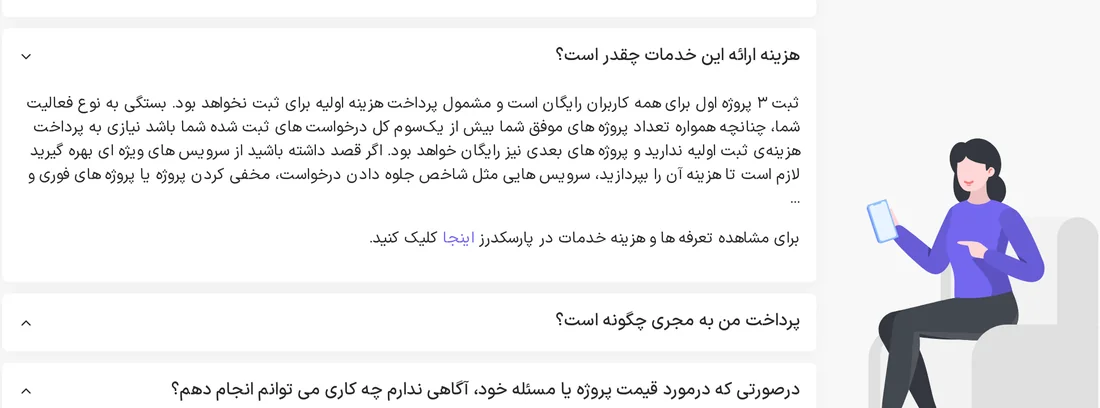
ParsCoders states on its own FAQ page: 15 per cent for standard contractors and, for premium accounts, between 10 and 15 per cent of the project value depending on account type, with a minimum charge. It works the example through too: on a project of 100,000 toman, 85,000 goes to the contractor.
The same page, on the buyer side, says posting the first three projects is free for every user and carries no listing fee. So their revenue model is legible: employers free, freelancers pay a percentage.
Lancerify is the middle case. Its FAQ says that buying a bronze, silver or gold subscription means paying a lower commission, but nowhere does it say what the base commission is or how much each tier removes. Information you cannot calculate with.
What this table does not prove
It has to be said plainly: the absence of a figure on those pages means we did not find it, not that it does not exist. It may be in the terms of service, in the dashboard after registration, or on a page we did not open. We recorded the exact URL of every page we checked and this test is repeatable whenever you like.
Our claim is not that these platforms conceal anything. It is that somebody who has not registered yet, and wants to know what will be left of a finished project, cannot find the answer in six cases out of seven.
Our position, with a figure we read out of our own code
Both the freelancer commission and the employer commission on the RGB freelance marketplace are zero. We are quoting that from our own plugin's settings file rather than from a marketing page: the defaults for commission_employer_pct and commission_freelancer_pct are both zero, and the admin settings screen says the same thing.
And now the part a marketing page would leave out. In that same code, both values are adjustable and the ceiling is 30 per cent. So today's zero is a decision, not a technical guarantee. If it ever changes, what you should expect is that it is announced before the change and that the new figure sits on a page readable without registration. Which is the same criterion we just measured everyone else against.
Zero cost also does not mean costless. A platform that takes no commission has to cover its costs somewhere, and in our case the freelance marketplace is part of a larger business. If a platform has no revenue source at all and takes no commission either, that is a question worth asking.
What to work out before choosing a platform
Commission is not the only number and sometimes not the most important one.
Percentage commission against a subscription fee. If you take one large project a month, the percentage costs more. If you take many small ones, a flat subscription may be better. Calculate it with your own real figures, not with an assumption.
The minimum charge. A floor like a fixed minimum is meaningless on a large project and raises the effective rate substantially on a small one.
Settlement time. A platform that charges less but holds the money for thirty days is more expensive for a freelancer with tight cash flow.
The dispute process. Read this before a dispute, not after.
And if you are the employer looking to outsource, the same care we describe in the sequence of a website project applies here too: define deliverables, not a feature list.
Questions that come up
What do Iranian freelance platforms usually charge? We do not have a single figure, because most do not publish one. The only number we saw from a platform's own source in this review was 15 per cent for standard ParsCoders contractors.
Is the commission taken from the employer or the freelancer? In the common local model, from the freelancer. Posting a project is usually free for the employer.
How does a platform with no commission survive? A fair question, and one that should be put to any platform making that claim, including us. The answer has to be a specific revenue model rather than a promise.
How do I find out a platform's commission? Before registering, open the terms and the FAQ and search the page for the word. If it is not there, ask support before starting your first project and keep the answer.
What if I want to hand the whole job to one team? Then platform commission is not the issue and the contract is. Handing a build to a single team removes the risk of coordinating several freelancers and in exchange reduces price flexibility.
Is working outside the platform not better? The commission goes to zero and so does the dispute process. Sensible for a repeat client you trust, not for a new one.
If you want to see what a zero commission looks like in practice, posting a project and receiving bids with no percentage deducted is what the code above describes. And if you pick another platform, at least ask it the five numbers in this article before your first project.


Comments & Questions
Have a question about this article? Ask, we'll answer.
No comments yet; be the first.